Wednesday, February 5, 2014

Applied Archeoastronomy: Prajāpati's Tears, The Horse, and Brāhmaṇic Hermeneutics (or, a Reply to Michael Witzel's "Magical Thinking" Essay)

"Students of the history of ideas are often preoccupied exclusively with the tracing of connections between ideas. This approach is too narrow and does not allow for the proper appreciation of some of the most influential men. A good deal of history, and of the history of ideas, too, consists in the untiring efforts of posterity to do justice to some individuum ineffabile (to use a phrase of Goethe’s). Socrates and Jesus, Napoleon and Lincoln are cases in point. So is Goethe." 
Walter Kaufmann: From Shakespeare to Existentialism

This short opening passage in Kaufmann's essay on Goethe and the History of Ideas is profoundly significant in further advancing our enquiry into the nature of the problem of traditional historiology in India. Indians are very often quick to trace various historical connections from Europe to India; they may do this by pointing to the "Arabic numerals", the Number Zero (śūnya), to early calculations of pi (π), or various forms of astronomical and mathematical genius, and so forth. This intellectual "heritage" of Indian literary culture remains in some sense valuable to historians today, but does little to enhance the basic existential condition of Indians living in an economically depressed, densely populated state.
If the history of ideas—or, if we can say, in the same breath, the idea of history—is to break free from a mere fossil record of past events, and is rather to become a living practice of enhancing the dignity of existence, then it must be admitted that Indian literature needs to be investigated with the partial aim of breaking away from the ossification of thought—to wit, from the uncritical thoughtlessness of super-stitions. Such a radical or critical take on Indian literature has already been initiated by the Western Academy and is well underway yet, to my reading, it has stalled out, or rather, has advanced in such a way that the meaning of the most ancient of these works has remained deeply obscured for those whose significance it intersects closest with (i.e., "Hindus"), and thus, the history of Indian literature—again, meaning in the same breath, the literature of Indian history— itself has gotten, to some extent, lost in the rhetoric of skeptical reconstructive efforts which fail to take the pursuit of the meaning of these texts with adequate sensitivity to the worldview related therein. This can only result in the further perpetuation—and indeed, ossification—of misunderstanding. 
How is it that Indian literature has lost its historical (or should we say, aitihāsika) voice? Why does the Western academy still for the most part disregard all classical Sanskrit historiography as specious and unreliable in its own right (cf., Pollack, Sheldon. Mīmāṁsā and the Problem of History in India)? More importantly, in our Postcolonial phase of Indological studies, can this situation finally be rectified? Certainly there are elements in the classical historiography of South Asia which present complications, elements of mysticism so seamlessly blended in with terrestrial events that one finds it naturally quite difficult to tell where one starts, and where the other ends. But if we were to have, at the very least, a consistent sense of the domains of being to which we could ascribe our narrative structures, or rather, if we might take the ontology of Indian literature as critical post-sign, pointing us to these domains, then we are well on our way toward disclosing the presence of data which indicate a discernible concrete sensibility in the classical works. Securing the elements of these domains are not light work, but depart from the enigmatic condition which generated the existential concerns to compose these ritual works in the first place. 
We are told that Vedic literature is, at its core, sacrificial, meaning, putatively—a concern with ritual activities bent on magically giving rise to desired fruits, or karma-phala. The early parts of the Vedic canon are for this reason often described as karma-kaṇḍa, or the "division of action", ritual action, to be precise. Yet the bases of the engine of sacrifice is to a large extent not given enough attention—at least, insofar as these bases constitute the original metaphysical  threads upon which the whole efficacy of the ritual was conceived to rely. Brian K. Smith, In his work, Reflections on Resemblance, Ritual, and Religion, has spoken of jāmi ("family relation"; cf., Wittgensteinian notions of "family resemblance") as a critical thread for ritual efficacy, and certainly, this element does play into the larger picture of Vedic ritual. Yet, there are other components whose hitherto underestimated contributions have prevented scholars of Vedic materials from clarifying such works as the Brāhmaṇa texts. Even Michael Witzel, one of the world's premier Indologists, admits to a number of obscure passages for which he is unable to find a completely sensible meaning. Witzel provides us one such example from the Taittirīya Brāhmaṇa:

'The horse is connected with Prajāpati'; 'The horse is connected with the waters'; 'The horse (aśva) has 'tear' (aśru) as its secret name'." 


Witzel is perplexed by the meaning of these "connections", as he states:

"When coming across the sentence 'The horse is connected with the waters', this seems to be an unintelligible statement as many of the equations referred to above. As far as I can see, no relevant noem, no important concept of our encyclopedic knowledge connects 'horse' with 'water'." Now, in essence, I do think that he has hit upon the right sensibility, as when he quotes: " "The gods love the hidden, the non-apparent" (parokṣapriyā hi devāḥ)" Yet I think he goes awry when he then considers this hiddenness to consist merely in the similarity of sounds. "aśva 'horse' is aśru 'tear' because they share, as in the earlier example of dakṣiṇā = dakṣiṇaḥ, a similarity in sound."

Of course, it may be that this "symphony" matters, in the sense of jāmi, i.e., the sounds being neither identical nor entirely different, but just "similar". Yet there are other elements that we wish to weigh in here. 
Witzel recalls the following myth to connect the horse with Prajāpati:

"This still leaves the relationship of the horse and Prajāpati unaccounted for. The solution, once luckily found in the texts themselves, is a rather simple one: A myth is related: 'Prajāpati (the lord of creation) wept. His tear fell down. Out of this, the horse developed. It neighed. It let some dung fall down, turned around, and sniffed at it' (- a good observation of the boundary marking habits of horses). Probably, this story would be remembered by a Vedic Indian if he were to explain the relationship of the three sentences about the horse mentioned before. The myth unifies these statements: The horse is related to Prajāpati, it is of Prajāpati- nature (prājāpatya) because it developed from his tear; it is related to the waters as it was born from salty water, from Prajāpati's tear. As it happens, both 'horse' and 'tear' sound similar in Sanskrit: therefore the hidden, secret name of 'horse' can be 'tear'."

Now, at this point, Witzel's explanation falls entirely to referring the meaning of one passage to another. And in this, we do find some sensibility. But we haven't discovered as yet anything which makes it feel compelling. I mean only to add this additional ingredient. Witzel himself admits that this explanation isn't really compelling but still appears as if a fabrication: "The problem is whether this explanation really answers the question posed by these three sentences. The myth which unifies them looks more like a fabrication in the fashion of the other varified tales about Prajāpati, which always come in handy as explanations, (cf. also H.-P. Schmidt 1979 p. 278). One could even suspect that the myth had been created because of the similarity of the two words denoting 'horse' and 'tear'." While Witzel leans on a rather phonological, noematic explanation, we have discovered an "missing link" of sorts, a hermeneutical cypher which signals the associations in more compelling terms. The problem again is that there is nothing very compelling about the noematic explanation; we, so far, don't feel that the Brāhmaṇas make any sense, even if they are apparently self-referential. It seems vaguely possible that Witzel's explanation is correct, but we simply don't have any motive that compels us to regard this as a good or plausible explanation. The phenomenality of the whole comparison seems more or less still lacking. 

But in fact, there is one domain in which this connection drawn between a "horse" and "the waters" seems to us almost strikingly plausible. For this, we need only look to the ancient obsession with Uranography.  In order to signal the somewhat idiomatic style with which the Ancient Vedic Brāhmaṇas undertook this practice, I coin the term, "Varuṇography," on the strength of Dumezile's Ouranos-Varuna essay. Among the earliest ontologies in the Vedas gives us the basic divisions of bhūḥ, bhuvas, and svar, or "Earth", "Atmosphere," and "Heaven". Sky, has been divided into two divisions, one seen during the day, one seen at night. Svar is "higher than" bhuvas, the atmosphere. And it is in the Svar, the heavens, that the devas, the divinities live. This alone already suggests that very many of the Vedic and Hindu deities (if not all of them) are directly associated with constellations. The work and method of determining these associations, I term as Varuṇology.  
It needs to be underscored that the methods I employ are a little bit elusive to the "uninitiated". It will not always be obvious where best to start, not least, because every postulate I will make here relies in turn upon yet other postulates which are not immediately self-evident. It is rather in the coherence of these postulates that I find the strongest form of evidence for the overall truth. No postulate here will stand on its own ground, but in every case, must be seen in light of the other postulates. Each postulate, moreover, is but one of several competing postulates, so that the identity of a given "connection" (to use Witzel's language) is not to be taken as total or exhaustive of the possible identifications. That one constellation is identified in a particular way in one passage in no way prevents that same constellation from taking on a whole new identity, even sometimes within the same narrative. Sometimes, constellation may play two or more roles so that it will seem as if talking to itself!  Hence, one finds that the rational process for securing the most plausible sensibility of the Brāhmaṇas' esoteric connections requires a bit of conceptual meandering, sometimes from one narrative to another, sometimes from one constellation to another, sometimes from one concept to another. We will, of necessity, short-cut some of this, and so, it may appear to our reader, for a time, that some of our putative postulates go inadequately substantiated. We beg the reader's patience in this regard, as we do have evidence which will become apparent in due course to those who are adequately familiar with Uranography, but which will require the reader to take up the study of these constellations as a crucial part of understanding the rationality of the "system". 
With that in mind, let us now turn to the constellations which, to my reading, provide us the most plausible lead for rendering sensible Witzel's own chosen example of "magical thinking" in the Vedas:
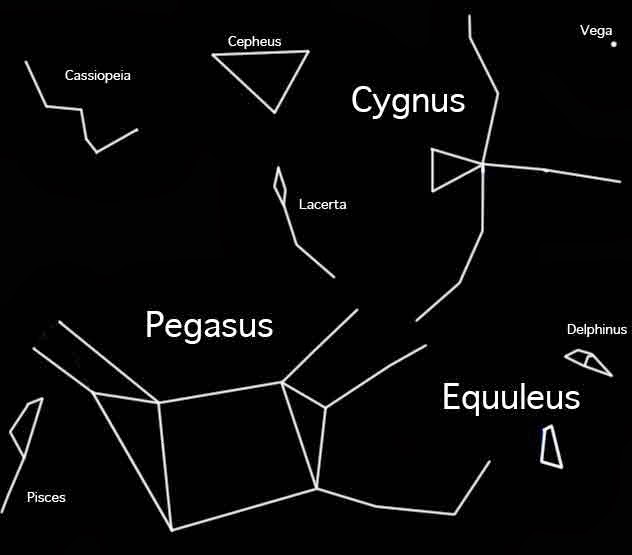


Of immediate significance are three constellations: Cygnus, Pegasus, and Equuleus. These three form a crucial trace of the original sense of this earstwise enigmatic passage from the Taittirīya Brāhmaṇa. Here we see that they are in close conjunction. Moreover, these three constellations rest in a portion of the sky known to antiquity as the "Deluge". We will not concern ourselves immediately with the original cause of such a name, but will only indicate the immediate symbolic sense of the term; this very large region of the sky is populated with constellations that are of an aquatic character. Among the "aquatic" constellations, there are, Pisces, Aquarius, Capricorn, Cygnus, Delphinus, and others. The earliest historical origins of such identifications for these constellations are to myself still a mystery, but they do make clear one possible meaning of "the waters" in Witzel's example (note also that "Winter" is derived from an older term meaning the "Waters", given that the Sun inhabits this part of the sky during the Northern Winter). This becomes more evident when we note that Equuleus' head is "alligned" with two prominent stars in Cygnus. This alignment provides us with one possible sense of "tear", for if we take these two stars in Cygnus—namely, Sadr (Sindhi for "heart") and η (pronounced "eta") Cyg—as "eyes" of Prajāpati, then certainly there are two traceable lines which form the "sides" of the "tear" by falling in a straight line from these eyes.  


Moreover, this image might suggest that Prajāpati gave birth to this Deluge with his own tears! We have elsewhere (forthcoming) made note of over 80 elements of convergence which collectively signal the identification of Prajāpati-Brahmā-deva with Cygnus. We will here mention just a few prominent indicators, which stand more well on their own, and so do not require further tracing to other postulates. For one, Brahmā is said to have a Swan vehicle (haṁsa). Another important signal, Brahmā is said to have four heads (catur-mukha) which correlates well with the four branches of Cygnus, generally drawn in a cross-like figure. Further, Cygnus is superimposed upon the core of the Milky Way Galaxy, suggesting its identification of the celestial Ganges, which is said to usher from Satya-loka, Brahmā's heavenly abode. The Astronomer, Raghava Rao, has also made this particular identification of the celestial Ganges. There are many other such postulates which further strengthen this single identification of Prajāpati-Brahmā with Cygnus, but many of them require delving into very complicated semiotic systems, so I will avoid entering further into that matter just at present. 
There is another interesting connection to consider here, in relation to Pegasus. It is notable that Pegasus is "upside down", a strange formation which occasionally catches the attention of archeoastronomers (this same curiosity is found in the constellation of Hercules, for example). If this was the product of an inversion in prehistory, we might expect what is now taken to be Pegasus' front as rather his behind! And this would further strengthen our reading of the "horse-head = Prajāpati-tears = horse-dung = Equuleus" thesis. Let us recall the brief myth which Witzel relates: "Prajāpati (the lord of creation) wept. His tear fell down. Out of this, the horse developed. It neighed. It let some dung fall down, turned around, and sniffed at it' " Note that the horse defecates, and then turns around to sniff it! Here, we see the Brāhmaṇa attempting to describe how it is that the Horse is upside down! Thus, this upside-down horse, Pegasus, indeed is quite old!
Now, if I were to be required to proved the identity of any of these mythic elements, without drawing evidence from other mythic elements, I would be left with a much more difficult—nay, impossible, task. But we do see here, a sensible, compelling reading of these Brāhmaṇa passages relating the horse to the tears of a creator God, and to horse dung.


Indeed, I will go so far as to argue that astronomical information is very frequently embedded in the passages of the Brāhmaṇas. When these elements are all taken together and identified, we will find that the texts are not as obscure or difficult to interpret as they were previously. Simply by attending to the question of the domain we are to investigate, Svar, we know where to look for further phenomenal data. This has the potential to constitute a paradigm shift for interpreting the semiotics of the Brāhmaṇa texts. How much more is in these works which we have hitherto failed to recognize in its phenomenal originality, only because we lacked the right sort of hermeneutic sensitivity, and were unable to previously determine the primary domain of inquiry, i.e., comparative archeoastronomy? 
A comparative archeoastronomy is thus greatly in need here. My research into this domain indicates that a treasure-trove of narrative tropes may be traced to astronomical—or rather, astrotheological—conversations held between various civilizations in hoary antiquity: elements which today survive in Chinese, Egyptian, Indian, Mesopotamian, Greek, Roman, and Norse astronomical narratives apparently pervade the Vedic works. Thus, close attention to comparative constructions can still greatly advance our collective awareness of the sense and meaning of the Vedic hymns, and may for the first time, hone the precision with which these hymns can be dated, using nothing more than semiotic evidence. In the end, this may prove one of the most precise ways to date the hymns of the Vedic Saṁhitās; if the ancient ṛṣis were being attentive to the general problem of describing the positions of the stars in the sky, perhaps they left us crucial clues to the historical origins of a calendar embodied in the sacrificial act. Did they acknowledge the ancient pole-stars? Which? With what hymns did they adorn them? Indeed, these being the "high-est" or "North-most" (ut-tama), can we say that the ancients, even prior to Hipparchus of Nicaea (c. 190BCE - 120 BCE), were able to understand the nature of axial precession? To determine this, we would need to be reasonably certain of the relationship drawn between the polestars and the yugas. And to do this, we would need to know the celestial who's-who of the Vedas. Here, we have managed to enhance the identification of Prajāpati with Cygnus, as well as Ucchaiḥśravas with Pegasus/Equuleus.
But this project ultimately rests upon the prior identification of hundreds of personas, objects, and narratives in the Vedic canon. Slowly, slowly, the Vedic world is resolving its identifications. Slowly, slowly, it is becoming evident why Viṣṇu, Brahmā, and Śiva "ascended" to the height of Monotheistic importance. Pandora's Box is opened, and there is no undoing what has become evident. What then can we say for the future of Astrotheology—to wit, the future of Hinduism? Time alone may tell. 

Bibliography:

Dumezile, Georges. Ouranos-Varuna: Essai de mythologie comparée indo-euroéene, 1932.

Kaufmann, Walter.  From Shakespeare to Existentialism. Princeton University Press, 1980.

Pollack, Sheldon. Mīmāṁsā and the Problem of History in India, Journal of Oriental Studies, 1989.

Raghava Rao, Gobburi Venkatananda. Scripture of the Heavens, Potti Sree Ramulu Telugu University, 1997.

Smith, Brian K. Reflections on Resemblance, Ritual, and Religion. Oxford University Press, 1989.

Witzel, Michael. On Magical Thought in the Veda. 1979.

Author Unknown. Taittirīya Brāhmaṇa.

Friday, January 24, 2014

The Cosmological Significance of Rāvana's Curious "Asshead" in Dating the Rāmāyaṇa (updated Feb19, 2014)

To those readers for whom Rāvana is unfamiliar, the ancient Vaiṣṇava epic (itihāsa), Rāmāyaṇa (pronounced Rah-mah-yuh-nuh), relates him as a powerful king of demons (rakṣāsas). The work depicts Rāvana as of a superhuman stature: he has ten heads, twenty arms, and metaphysical capacities of various sorts; for example, in battle, when any of his heads are cut off by Rāma, he grows new heads in its place (much like the Hydra of Greek legend). 

Toward the beginning of the Rāmāyaṇa's "second act", Rāvana abducts Prince Rāma's lovely wife, Sītā. Consequently, Rāma befriends a clan of Ape-men (cf., vṛṣākapi) and other animals; with their aid, Rāma seeks out and pursues Rāvana back to Śrī Lāṅka, where, having slain the demon king, he reclaims Sītā as his own. 

The other day, as I was perusing the omniscient internet for plausible leads regarding Rāvana's celestial identity, I came across a very remarkable image. A number of traditional South Asian images depict one of Rāvana's heads as that of an ass or donkey. I was surprised to find this, as I had never come across it prior (for one thing, some of the images suggest that he has eleven heads, not just ten). And of course, as I looked for explanations, I found a few duds, which put a "the moral of this story is. . ." on an otherwise very curious element, thinking that they had thus settled the matter for good (this method is more common than it should be: note how one conversation winds up going no where in particular).


Rāvana is, quite literally, an Asshead.


For various reasons, a bit of which I will go into below, I suspect that this "Asshead" feature actually discloses Rāvana's celestial locus in the region of Boötes. This further suggests other important associations, such as the locus (loci?) of Sītā.


Our Provisional Hypothesis:
A) Rāvana is identical or nearly identical to the Constellation, Boötes (or else Hercules, or both),
and 
B) Sītā is identical or nearly identical to the Constellation, Ursa Major (or else Corona Borealis, Ursa Minor, or all three).

The Evidence:

1) The Boötes/Plough connection = Rāvana stealing Sītā (her name means "tip of the Ard Plough" [cf., "sītā" as "tip of the plough" in the Ṛg Veda]. 

a) An Irish commemorative flag dedicated to the "Easter Rising of 1916" depicts Ursa Major as the "Starry Plough";1 apparently, this is an old tradition in the region of the UK and Ireland, though I've not been able to trace its earliest origins as yet (note the reference here, as elsewhere...). The geographic remoteness of this tradition, represented on the one hand, in the far West of Europe, and on the other, in South Asia from antiquity, is somewhat suggestive of an even more ancient source; perhaps Roman, or perhaps even earlier, coinciding with the Gaelic exodus from the Caucusus Valley. We know, for example, that the ancient Norse legends identify Ursa Major as the "Man's Cart", and Ursa Minor as the "Woman's Cart"; 

The significations of UMa/UMi vary widely, but a farming instrument is common (cart, scythe, plough). As such, it is present in numerous traditions in ancient Mesopotamia (ex., St. John's vision "I hold the keys of Death and Hades" [Revelations 1:18]). Other interpretations include a horse and a bear (I doubt that I've exhausted the possibilities here). 

b) Sītā is "unearthed" when her father is running the plough in a ritual through the Earth. Being the "Tip", she may well signal a single star, rather than the whole plough. This would suggest one of two dates (a: when UMa is ascending into "Vaikuntha", or b: when UMa is descending into the Earth; the former hypothesis has in its credit, that Sītā finally descends into the Earth at the end of her life. Further, she is said to have been born at a time prior to the Kali-yuga, while that star descends well into the Kali-yuga. Naturally, these dates should be calculated from the position of the site that Daśarātha is related to have unearthed her. Further determinative, Wikipedia mentions that Sītā's "Birthstar" is the Aśleṣā Constellation (the seventh, later ninth, lunar mansion) in the month of Chaitra.wiki:Sita. Rāma's father is named "Daśarātha" or "Ten Chariots" = Rāvana's other name is Daśānana or (Ten heads)
Noteably, Rāvana Doesn't take a significant role in the story until after Rāma's father has died. This may indicate that the time of death coincides with the Ω date for a particular star, which we have yet to identify concretely. (Note: The terms, "A date" [alpha date] and "Ω date" [omega date],  refer in this essay to the periods in which stars enter into a region of the sky known either as "Satya-Loka" or "Vaikuṇṭha".


These terms indicate that, unlike other stars seen from the equatorially-proximate longitudes of the Earth, they do not descend below the horizon, nor ascend from beneath it, but become, as it were, more or less "permanent" fixtures in the Northern sky, due to a close proximity with the Northern Zenith, some of these, for millenia (the duration of such a state for any particular star depends in part upon their proximity to the "Wheel of the Yugas" (a matter I take up elsewhere), and in part to the point of observation from the ground (the further North one is standing, the longer the apparent A and Ω dates are apart from each other; hence, determining the apparent observation site matters critically to the dating of the works that describe such events). Much like the North Star (Polaris, i.e., α Ursa Minor), they neither rise nor set. These periods thus assign a terrestrial "life" and "death" of such stars (cf., the four Kumāras curse Jāya and Vijāya to incarnate as demons).


note how many of the stars in this video do not set below the horizon, but simply circle about overhead in the northern region.


3) The "Ass" constellation in Boötes plausibly correlates to Rāvana's Ass-head
There are three stars which ancient tradition associates with Donkeys, known as Kappa, Theta, and Iota Boötes. I imagine that the triangle these three form does in some sense approximate the narrow shape of a donkey's face, with ears pointed upward. There is another set of stars which are also associated with Donkeys, and which thus provides us two "contending" loci (the alternative set are located in the constellation, Cancer). We might suppose Cancer's stars as a candidate, but they are quite distant from any of the stars that constitute Hercules, Corona Borealis, Boötes, or Ursa Major. As such, I regard them as less plausible candidates. 


Note that the Lynx and Leo Minor separate Cancer from Ursa Major.

4) By virtue of the Rāma-Hanuman-Lakṣmana = Hercules-Corona Borealis-Boötes thesis, Sītā naturally follows in a straight line. 
In much of the traditional Śeṣa-Śayī-Viṣṇu iconography, Lakṣmī sits at the foot of Viṣṇu, massaging his foot. I suspect that this signals either Corona Borealis or Ursa Major. Notably, A portion of Ursa Major is termed "the thigh" (according to Egyptian astronomers), lending weight to the UMa thesis. 


Note that Viṣṇu's bent knee matches the basic geometric shape of the upper part of Boötes.  Ananta-Śeṣa, the Many-headed Divine Serpent (nāga), additionally matches with Draconus and/or Serpens well in this account.

5) This quote from Frederick Smith's The Self Possessed: 

"Hanumān as lord of bhūt-prets is reminiscent of other deities who command armies or troops, notably Gaṇeśa, "Lord of Hosts," usually of undefined character or, more appositely, of Khaḍgarāvaṇa, a minor deity often associated with possession, who is specifically called bhūtarāja (King of Spirits) and bhūteśaṃ (Lord of Spirits)." (Ch. 4).

The connotations here draw a line between Yāma (judge of the newly dead), Śiva, and Balarāma. Note also that Hanumān is himself referred to as "Bālā-jī", connecting him to Balarāma, at least in name. The locus of Rāvaṇa is plausibly that of Boötes. 

The Inference:

(α) Sītā is either Ursa Major as a whole, or some portion thereof, or partially contained within Ursa Major.
And,  in light of the instabilities of the auspiciousness/threatening appearance of constellations, 

(β) Boötes (who is identified with the Grim Reaper, or Yāma), can play a double role, sometimes as Rāma's brother, sometimes as his enemy. 


Some Lingering Questions/Problems:

a) Concerning Rāvana's "Ten Heads", are these ten discernable stars in Boötes?
b) Are these ten heads the very same as Daśarātha's "Ten Chariots"? 
c) What, if anything, does this suggest about the Time of composition for Valmīki's Rāmāyaṇa?? 
d) If Hercules is the Greek equivalent of Rāma, does this make Corona Borealis also Rāma's Cakra? 
e) Which star in particular is Sītā's? β UMa? h UMa? (both are significant contenders, given the variant depictions of UMa over the years and in different traditions; both give significantly different Α/Ω dates). 
f) Does Valmīki mention Sītā's birthstar as in the seventh or ninth lunar mansions? This might help indicate an earlier or later date for his Rāmāyana...

As you can all see, this investigation is far from over. But it does at least provide us with some important cosmological grounds for advancing the inquiry further, while suggesting crucial astrotheological features of the whole narrative.

Tuesday, October 8, 2013

Durgā, Understood in Cosmological Perspective

There is presently a massively popular nine-day festival building up to its crescendo in Kolkata. The festival is named variously, "Durgā-Pūjā ("The Worship of the Durgā"),  Nava-Rātra, or Nava-Rātrī ("Nine Nights"). The festival has brought massive crowds this year from numerous states to what is already counted as among the most populous, dense cities on the planet. Indeed, the long-distance trains from as far as Delhi (about 1000 miles away) have been more or less fully booked from at least one month ago, according to a friend who was subsequently unable to join us. And one of my local Kolkata friends told me that she will not be attending the festival simply because the crowds will produce such a pressurized environment that it becomes a major endeavor to simply walk ten feet from anywhere you are standing at a given moment. Of course, this is likely to be true only to be the case "at the center of the action." But then, where is that center? 


As it turns out, the "center" is actually a plurality of sites, numerous "pandals," or temporary temples, set up throughout the city of some 12 million residents. These pandals have been going up for months now, some of the larger ones since late July or early August. Almost all of those I've seen so far have been constructed from a bamboo skeleton, overlaid with clothes of various colors nailed to wooden frames, or fired clay.


These pandals can be seen peppering the various neighborhoods of Kolkata, sometimes taking over the whole space of a small park. 


There are internal platforms, and deities. Lots of deities. 


They are colorful, diversely styled, and will be occupied, at the height of the festival, by an important icon, Durgā-Mā. Durgā has been translated variously, as either "Fortress" or "Prison," depending upon the attitude a tradition holds toward her. More literally, her name means "hard-go"; this may refer to the passing away of the difficult weather that comes as a great relief at this time of year, or some other image of Time. And of course, the fall is almost universally famous as a Time of harvest, often depicted by a stalk of barley held in the hand of Virgo.


Virgo's significance should be given its due. For one, the Sun has been in the constellation for a couple weeks now. And the festival commenced with the new moon, or when the moon passed near the sun already in Virgo. In this way, Virgo is a constellation that rises with the Sun every morning at this time of year. But just as significant, another constellation, Taurus, is simultaneously receding on the Western horizon. It is thus significant that the most popular icon of Durgā depicts her slaying a "bull demon," Mahiśāsura. And what is more, she is perched upon a Lion while doing so. Of course, Leo is situated directly between Taurus and Virgo, on the Side of Virgo. All this would seem to indicate that the icon, far from being the capricious invention of some whimsical imagination, is an attempt to capitulate the season in a way that reflects events unfolding in the cosmos above.

As Virgo, the Youthful Goddess, behind Leo, rises in the East, Taurus Sets in the West.

Unfortunately, the activities of the stars can hardly be seen in Kolkata at this time. The sky here retains an almost constant haze from the tropical high humidity of the Monsoon season. As such, very few stars can be seen, except in glimmers here and there. And without this wonderful nocturnal display, it perhaps becomes a little bit difficult for the unschooled layman to appreciate the role the stars play in giving significance to his beloved icon. For how long has the lay Hindu contemplated the deity in clay, straw, and paint, while ignoring the stellar sources of these images? 


Thursday, July 11, 2013

Tracing the Riverbeds of Iconoclasm

This is a two-part video lecture in which I discuss the history and ontological formalization of iconoclasm, its Indo-European religious components, and its future. In particular, and insofar as I am am investigating this theme in relation to the theme of Time, I am looking at iconoclasm as, in part, a product of metaphysical modes of diurnal/nocturnal opposition. This reflects Immanuel Levinas' own tendencies to speak of theology in a Nocturnal language, as an exposure to the Infinity disclosed by "Height", and which I take to be indicative of the basic astro-theological character of Indo-European religion. Moreover, it is important to note that, at least by this astrological standard, Semitic religions are not "anti-Indo-European," but rather show themselves as a variety of such, if not linguistically. In this case, and historically speaking, both the Indo-European and Semitic religious tributaries are complicit in "iconodulatry" and "iconoclasm," and both reap its fruits, both in terms of theological criticism and violence. But what is even more important, neither are thereby ultimate causes, which I would suggest rather traces to Historiological Time itself: in our awareness of Time, we become entrenched in a Globalizing mentality, one that Universalizes by through the disclosing and destruction of possible futures.  This argument follows the view that the birth of History is itself a synonym for the End of Time, or "the End Times." In this respect, Post-Modernity figures as just one more phase in the enigma that is Historical-Being, and as such, is already in one respect anticipated and even transcended by the thought of the Gītā, which regards Time as the very limit of thought and action.  

Part I: 


Part II: 

Saturday, July 6, 2013

The Curious Case of Rāmānujācārya vs. Yādava Prakāśa: Interpretation Theory and Heresy in the Chāndogya Upaniṣad


tasya yathā kapyāsaṁ puṇḍarīkam evam akṣiṇī |
tasyod iti nāma | sa eṣa sarvebhyaḥ pāpmabhya uditaḥ |
udeti ha vai sarvebhyaḥ pāpmabhyo ya evaṁ veda || 
Chāndogya Upaniṣad || 1.6.7 ||

The above is a rather curious verse from the Chāndogya Upaniṣad. Scholars have placed the work among the older Upaniṣads. The Wikipedia page places its likely date of composition between the 3rd and 8th centuries prior to the common era. While I am personally reluctant as yet to assign a probable date for the work, it probably dates from same linguistic-conceptual period as the Bṛhad-Āraṇyaka-Upaniṣad, if not slightly later, whenever that was.

But debates concerning its origins aside, the work is more interesting to me for its curious use of the term, kapyāsam, in the first line of the above verse, and the multiple valences this term took on in a famous debate that marks the beginning of the Śrīvaiṣṇava tradition. The rather heated, even vicious debate (over the Vedic author's original intended meaning) which flared up between the still young yet clever Rāmānuja and the elderly Sanskrit guru, Yādava Prakāśa presents us with a striking example of the problems in reading Sanskrit while lacking an adequate regard for the cosmological setting in which it plays out. 

If we refrain for the moment from translating this single term, the rest of the line just states, "Just as a kapyāsam is, His lotus eyes are like this." (The verse is describing God's countenance). 

You see, Yādava analyzed the term, kapyāsaṁ, down into what might appear to be, grammatically speaking, the most direct translation, meaning "monkey's derrière"  (kapi-āsam). This became an offending vigraha for the young, devoted Rāmānuja. As such, it became this young Sanskritist's mission to outmode his own guru's understanding of Sanskrit. 

According to Rāmānuja, the vigraha (analytic form of the compound) gives us kapinā (by the sun) āsaḥ (blossomed). Hence, a "lotus flower." Of course, I am not prone to deny the validity of Rāmānuja's reading. However, it is significant that the Vedas and their various commentarial branches are well known for playing with polyvalence and homophony—meaning that, often times, more than one meaning was probably intended by the author.

You see, the word kapinā is phonetically quite close to kaupīna. Here, we see a bit of Rāmānuja's wit. Even in offering a clever retort to his guru's analysis, Rāmānuja engages in a little "tongue in cheek" grammatology, noting the reference, but also assuaging what he percieved as a "crass" rendering. But the question does remain: how is it that monkeys, behinds, loin-clothes, lotus flowers, and eyes are supposed to be related? Is it that they are supposed to all reflect a similar color of red? Or is something else, something more significant, going on here? I suspect so, for reasons I will shortly make clear. 

Let us consider this case in light of archeoastronomy. For one thing, it is well know than much of the literature of the late Vedic period, a period roughly corresponding to the composition of the Chāndogya, displays a complex, flourishing cosmological culture of discourse, much of which included literature dedicated to the transmission of traditions of astronomical heuristics, such as the use of mnemonic narratives to aid in the recognition of complex but relatively stable patterns of stars. And from even the limited research I have already performed, it is already quite clear that this culture of astrological discourse figured prominently in inter-cultural exchanges (for reasons that would be obvious to any Premodern traveller in need of accurate navigation skills). So, in this case, we find that there is a long-known Chinese constellation in the location of Corona Borealis which translates as "coiled thong." And it is easy to understand that kaupīna makes for a quite suitable Sanskrit synonym.

But let us also consider that all Hindus know of a very famous monkey, Hanuman. "Hanu-man" (or in stem form, Hanu-mat), just means, "Possessing [a/the] Jaw." Various commentators have provided various connotations of the name, such as "having a [Broken] Jaw," which we are told came from his brief encounter with Indra, when, as a child, this monkey tried to swallow the Sun whole, thinking it a ripe fruit, and thus expanding his earthly form into a cosmically enormous giant in order to accomplish this end. After knocking him from the sky with a thunderbolt, Indra blocked this power and Hanuman's memory of the event, until such a time which would call for him to utilize it in the cause of dharma. And we suspect (not just a little) that such a narrative is supposed to explain just how an enormous Jaw-shaped constellation hangs in the sky as we see it today, or else, that such a narrative was intended to make those stars memorable in their specific constellar shape and "celestial neighborhood." 

This cosmic connotation becomes even more circumspectively apparent, when we recollect several other elements from the narrative cycles of Hanuman, such as that he became a life-long celibate upon swallowing a kaupīna, or else, that he is well known for carrying Rāma (whom I have elsewhere extensively argued as bearing significant connections with the Hercules constellation) and Lakṣmaṇa (who matches exceedingly well with prominent features from the Boötes constellation) upon his shoulders in the famous battle with the fierce rākṣasa, Rāvana. For reasons that are somewhat difficult as of present to make plain (for the complexity of inference and yet other complex narrative structures that must be brought to bear in any "totalizing" proof), I also take it that Hanuman's famous episode of carrying a mountain upon his shoulders in order to save Lakṣmana from Indrajit's poisoned arrow may be traced to a set of discrete constellations (namely, Corona Australis and Ophiuchus). 

In any case, we should be able to see by now how the "monkey" and the "coiled thong" make for suggestive polysemes of Corona Borealis. But what about the "lotuses" and "Viṣṇu's eyes"? 

Well, this requires us to take a closer look at the constellations local to Corona Borealis. The late Vedic materials take great pains to draw lines of inference and simile between various worldly phenomena, both Earthly and Cosmic. Among these, it has become plain to me that Megasthenes, the ancient Greek doxographer and early tourist of South Asia, was not misconstruing matters in his book, Indica,  when he related the cult of Kṛṣṇa as the same as that of Hercules. Indeed, the stories turn out to have so much overlap that a mere coincidence appears to me as highly implausible. Some scholars have even gone so far as to suggest that the name, Hercules, derives from a Sanskrit predecessor, in the neighborhood of "hari-kula-īśa," literally, "Lord of the Dynasty of Hari." I do have reservations about the authenticity or certainty of this derivation, given that it violates a poetic sensibility regarding redundancy, but it is nevertheless a possibility, particularly if we are not required to suppose that the term was coined by a community who knew the poetic tradition intimately. 

In any case, if we take Megasthenes' comments as trustworthy doxography, then we contact the very tip of what appears to be a rather massive, polyvalent iceberg of ancient astrological data regarding the original posited position of Viṣṇu-Nārāyana. In the Purāṇic and related literature, Viṣṇu-Nārāyana is very frequently described as laying upon a cosmic serpent (either Draco, Serpens, or even Both!). This provides further evidence for his location in the very place of Hercules, situated directly between Draco and Serpens, laying right along the thick band of the Milky Way which stretches visibly across the night sky.

If we can allow ourselves for the moment to assent, even if only putatively, to the hypothesis that the celestial region of the Hercules constellation is the core locus of Śeṣa-Śāyī-Viṣṇu, then we can ask about his accouterments, such as the cakra (wheel), śaṅkha (conch), padma (lotus), and gada (club). I cannot say with complete confidence where every single one of these is (I have significant suspicions for each, but am hesitant to disclose more until I have more thoroughly processed the broader issues surrounding their cosmological identification), but I am already very confident about the original locus of the lotus; you may well have already guessed that I mean Corona Borealis. 

But further, I take it that Corona Borealis is also associated with other "iconic" themes from the Vedic cosmology, such as the Banyan Leaf upon which the infantile Viṣṇu lay while sucking on his own toe, or else the Vaijayanti garland Viṣṇu is often described as wearing, or even the lovely countenance of Subhadrā Devī. 

So, it only makes sense that, as the constellation Corona Borealis resembles the shape of a closed lotus flower, it comes to signify this, but alongside a number of other narrative accretions, because it remains comparable to yet other Earthly objects of similar shape (if not size!). And here is where we get to the curious crux of the debate, a debate which I have previously always encountered as between the impersonalist, non-dualist Vedānta school of Yādava in opposition to the personalist, dualist Vedānta school of Rāmānuja: What are they really up to in their interpretations of the Chāndogya's use of the term, kapyāsam? Do they believe that they can control the very quality of the universe merely by debating the grammatical intentions of ancient poets' musings concerning its various constellations? Are they doing this intentionally? Do they even know that they are debating what amounts to the conceptualization of Corona Borealis? Or has this conversation come to signify something entirely different, something that has left almost entirely behind those Vedic-cosmological valences? The tendency to play on the above specific polyvalences in the course of the conversation would seem to suggest otherwise. Yet, if they are so self-aware, in what sense is this debate about transcendental matters? Is it, as Immanuel Levinas suggests in God, Death, and Time, that transcendence has a regard for impossibility long before it becomes a concern for taboos? 

Sunday, April 7, 2013

On Encoding and Decoding Iconoclasm


I gave a presentation at the University of Virginia about a year ago on the ontology of iconoclasm, called "Tracing the Riverbeds of Iconoclasm." It is a very interesting and important topic, I must say. My rationale for including this in a blog on the concept of Time in South Asian thought has much to do with the fact that Time is a problem for phenomenology in that it doesn't have the phenomenality so readily ascribable to Being. Thus, represented as a "wheel," it is at once iconic and aniconic, for it is not an "idol", a personal substitution, a symbolic deity, but is a technology, a "device." But if "putting an image to something non-imagistic" constitutes a kind of iconoplasty, the creation of an icon, then what might we call an iconoclasm of Time?

Time is probably the first iconoclast. And I don't mean this is a merely mythical way. I mean that Time is likely to be that root from which iconoclasm first arose. It is a "first cause" of sorts, a significand that one cannot point to, because it is everywhere else, always already there on the scene, working behind the scenes, exposing us to its dynamics, setting us up to see it but in the mode of erasing whatever is seen. Time erodes the image, shows us that the image can be broken, that it lacks "magic." It does not defend itself, but must be defended by devotees.

Yet one would think that Time needs no defense, that its facticity could scarcely be denied. One would be wrong. Consider J. M. McTaggart's "The Unreality of Time." McTaggart's rigorous and unreflective application of the exclusion of the middle term to all things temporal would be negligible if his influence had not impressed itself so thoroughly upon the analytic tradition (computer programmers, lawyers, and arm-chair philosophers all). As such, it seems necessary at this stage in history to press back against the absurdities of such claims.

But how does this relate to the Euro-American history of Time and Iconoclasm?

It turns out that some of the greek myths seems to figure iconoclasm as part of their culture of philosophy. Take Zeus's substitute for example, a stone swaddled in cloth, given by Rhea to Chronos (Time personified), who consumes it. Or else, Chronos himself, turning his father, Ouranos (Aeon personified), into a eunuch with an adamantine scythe, or the brothers of Chronos, Titans (the strainers), hated by their father, and thus immobilized in the Earth (Gaia). All of these narrative tropes suggest a negating valence, a trickery visited upon the association of stone with life, a rigor mortis that prevents the animus from acting, an insult to the spirit visited with destruction, or else, breaking off the power of  animus, to create, to self-perpetuate.

Iconoclasm erodes history. This could also be called "the recursiveness of historical reflection." Brainwashing is not too far from iconoclasm at its root, since it tries to "erase memory." Nowadays, it has become fashionable to engage in sous rature, linguistic iconoclasm. One does not write, "God," but "God." The idea behind this novelty is that the name "God" is inadequate, yet necessary. In this sense, the author is mindful of the future, gives voice to an intuition which has not gotten teased out yet into a fully clarified concept. The image is not in fact so far from Jesus as "Christened", as ordained for slaughter. Christ, the God mutilated and hanging from a cross, is an image of iconoclasm par excellence.

But at the same time, this practice of writing under erasure, "clears" in the selfsame mode of a lumber company. Such a company, in entering an old growth forest, marks trees deemed fit for lumber with spraypaint, much in the same fashion of "strikethrough".

Yet what remains unclear to me is not whether these old-growth trees are worthy of preserving in virtue of the fact that they are living entities, albeit vegetative, but rather whether the corporate entity under whose governance such erasure today proceeds to mark terms for future deconstruction understands the true value of the wood and the value of the life that has given it its structure. "God" is a name so old that we have almost entirely forgotten its meaning; nothing like "Flying Spagetti Monster," which as yet can claim hardly an iota of heritage for itself. This word in particular is marked for deconstruction because one does not yet recognize the blossoms and young shoots jutting out here and there. Much of the tree is covered in a thick bark that would feign rot and death to the undiscerning eye. But this is the manner of all cirañjīvas, those that live long enough that their beginnings are forgotten by history.

Iconoclasm, like progressivism, looks only to the future, calculates, anticipates, or strives to anticipate, wants to get the future wholly in its sights, wants to overtake the visible, the imagistic, stone, paint, wood, and metal by the invisible, the clandestine, the occluded, shrouded in darkness and secrecy. Iconoclasm, like erasure, forbids the significance of itself from coming to light; it does not want exposure, nor identification, but moves as thieves and vandals do, the faceless mob.

But we can name iconoclasm even without effort: kāma eśo krodha eśa | This one is lust, this one is wrath, the eternal enemy who is like fire, all-consuming.

Yet today, lust and wrath predominate in media, as if exposed, 𝑎𝑠 𝑖𝑓 even wanting to be exposed. Our times are so very strange in this respect, that lust and wrath are in some ways considered to be the vanguard of respectability. And memory falls all the time further from the public space.

Tuesday, March 5, 2013

Reframing the Question of God's Existence as "Prime Mover" within the Question of Kṛṣṇa as the Personality of Time (Part I): The Debate over Ontology and Ethics


Europe's Traditional Understanding of Judgment as Pertaining to The Question of God (the Name Whose Original and Final Meaning is Up for Debate): Kant and Hegel, Architects of Modernity 

In Western philosophy, there have been a number of parochial philosophical scandals; a number of doctrines that appear coherent at the surface for some, but which for others produce counter intuitions and thus give rise to conflicting accounts (these may be thought as mutually exclusive, though such an intuition may itself turn out to be an error of prejudgment, of passing judgment before sympathetic understanding has been accomplished). We have Kant and Hegel to thank for bringing this concern to the center stage, and for thereby determining that the European history of philosophical debate was really always about bringing these conflicts to a certain end, thereby bringing about certain, or apodictic, knowledge, i.e., Truth with a Capital-T. In their account, "intuition" and "counter-intuition" (or "thesis" and "antithesis") gives rise to a dialectical question of the possibility of a "superficial, egocentric, merely-subjective assessment of facts." Alongside--or else, inside--this dialectical question arises the perception of a need for an authoritative judgment between the ultimate origins of authority and error, or knowledge and ignorance, take and mistake. And inside the domain defined by this concern, we first see the arising of value-differences, and their role in disagreements of any variety. I take it that the tradition would say that all of this follows from the question of whose judgments are founded in the real, in the common fact, in the "True world of things, of facts." "Facts," in this trial, are the jury members, the final arbiters of truth and falsity, of the innocence or righteous (cor-rectly-founded) authority of authentic knowledge, and the guilt (the culpability, justification for being-cor-rected) of error.* 

So it is, for many, concerning the question of God's existence, though of late I have been more comfortable with framing the historically prior intuition as "the question of God" or "the question of God's Personality" (Hegel, though he might have changed his mind by now, had he only lived long enough and retained his senility, at least agrees with me in his 1827 Lectures on the Philosophy of Religion in supposing that religions of mystery or enigma are prior to the Christian concept of religion). But the phrase "the question of God" might be taken by some as "God's question," wherein we are to investigate what sort of question God would ask, if only we could know His mind and will (and again, from my rather rough reading of Hegel's speculative historiology of "second stage anithetical religions," I take it that he saw the rather implicit thread relating mystery religions with monism, whereby one takes a further step from the initial question to imagining that one is justified in claiming to know God's mind in full, oneself being fully One-with-God, in every sense of that phrase).** But what I mean by this phrase, "the question of God," is previously in the sense of the name, "God" (though perhaps God would know how better to ask this question than I); yet, at least with the name, God, we have a concrete phenomenon, whether or not we know just how best to fulfill it intuitively. Certainly, we don't question that the name, God, exists, at least as being-within the domain of sounds or texts. People of varying languages or doctrinal persuasions may prefer other terms, such as Viṣṇu, Kṛṣṇa, Śiva, Brahman, Allah, Jehovah, Jesus Christ, or what have you--or else, may shy away from vocalizing the term, hence keeping it separate from the domain of sounds--but "God" is a fair conventional term for the most part, that, at least in the textual tradition, gives us a phenomenon as such to remark upon. This name's primary value is perhaps in its nearly universal use, as this keeps alive the intuition of the universal (though I have notably hereby excluded non-theistic traditions; c'est la vive). By "God" then, I mean the God of monotheism, in however many flavors that may come, but in each case, in the way that the believer oneself takes that meaning; I do not pretend to know the full variety of types, but I have at least been attentive to investigating the range for a while now. Yet it is clear to me that the God of monotheism looks as much like the Gods of monotheism, which is to say, there is along with this general topic, the oft-posed sectarian question of "Who knows God best?" or else, "Who's God knows best?". 

The direction for our investigation has now been set. We are at least on the primary concerns to look for in the history of philosophical discourse. Not least, we have determined that the question of the meaning of the name God may be determined as "Personal", "Existent", or "Mystical." And this does help us to establish the Vedic understanding of the God of monotheism, as originally named Time.   


Intuitions, Objectivity, the Universal, Evidence, and the Ought

I have given the reader quite a bit to chew on already. But we are just getting started. There are other matters here which must come into play before we can make clear sense of the original relation between the Prime Mover and Time, though the intuition may already be sensible to some just from seeing the two terms juxtaposed in this way. 

But before any sort of purportedly sectarian inquisition can be allowed to proceed with clear and unerring jurisprudence, in which we are supposed to determine who is the sapient-most authority and who the parties guilty of greater rational or spiritual error, the question of the sense common to both defendant and prosecutor is foremost the crucial aim of any holistically meaningful dialogue. God is big enough a concept that we shouldn't expect any one person's perspective to be comprehensive (save perhaps for that which comes directly from God's own lips); what is more generally the case, we have specific persons who are more and less familiar with the character of the question of God. But this allows for a certain kind of objectivity, in that the debate is a common, public one, and the revealed sources are both legible for the literate, though familiarity will vary. In the intuition of the objective, we at the same time have a demonstration of an intuition, an ideation given as God. This is to say, in the case of the question of the objectivity of God, the intuition of the universal is already a movement that draws toward "God" in the monotheistic sense, insofar as we have there an intuition of a single originary cause; perhaps Aquinas' so-called prime mover? If we make the case for a monotheism, we at least need to assume that a monotheism, as generally understood today by the popular imagination, signals God as if prior to all that is. But this notion of "first" or "prime" is perhaps not made any clearer by assuming that there is a "nothing" prior to this "first", a "zero" prior to a "One." As a "beginning," or "cause," we have only arrived at the intuition of God as the sine qua non of existence, the without-which-would-not-be; the faithful take it that whatever is, is be-cause of God.

Yet this does not give us priority in the sense of "first A, then B,"--where God is A, and all that is is B and these occur as by a temporal, and hence, causal, sequence. Close attention to the basic pre-dogmatic, pre-traditional intuitions of our concept of God and this concept's rendering through our intuitive orientation toward Time, shows that all we have arrived at is the sense that there exists a Universal situation of God as opposed to a Particular situation of God as historically interpreted, so that we have a concept of God, here understood as Such, God as God: Got-an-sich.*** This understanding does not give us any justification for concluding God as "what is prior to causation as such" or a "prior to the manifest as signaled in the possible." God is not, in this "priority," merely a promise of the possibility of being. God Himself already stands as a "prior condition for being", so that one must think of God, as in this respect Being-Eternal. This Being-Eternal is an intuition about Being that derives from a cosmogenetic reflection. In saying that God is "prior to" Time, there is a tendency to then think of Time as "after" God; but how can this concept "after" no less in this very special case be made sensible when "after" is itself a concept that Time mediates! 

Hence, in this unique case, of this interpretation of meaning which takes together the identity of God and Time, is not akin to another idolatry, like that of Golden-Calf-worship or Sun-worship. It does not amount to one more face of the amorphous, polytheistic, animistic cult. It is in itself a new and crucial order of religious reflection, even if comprised from a ritual language utilized previously as the polytheistic, the henotheistic, the pantheistic, or panentheistic. Contra-Hegal, I take this moment in history, wherein Time announces Itself as the first of Gods in South Asian sacred literature as quite plausibly the first to give rise to monotheistic conversions, to the burgeoning transcendental intuition of an authentic universal. Yet there is still a highly confused matter here, which might not appear as obvious to those whose current intuitions are built up from foundations first laid in antiquity via Greco-Roman myths; for, Time as a Deity is not just one constellation of heavenly factors, as if at war with other heavenly factors, or "taking turns" at dominance, as with the panentheistic concept of divinity; there is no diety in the panentheon adequate to the power of Time, as if according to the generational myth of Titans and Olympians; however late Time is born into the specific scene (if such a phrase ought even to pass as well-reasoned and fully intelligible), there can be no doubt that Time itself was also prior to that; Time is the priority of the prior! What would be prior to Time, were such possible, would be entirely insensible and even counter-intuitive to careful and clear reasoning.  Time is itself always and already the outmost circumscribing domain of the possibility of generations! Indeed, Time is the very Possibility of possibility as its first, intermediate, and final forms! 

We invoke Time in the very act of thinking as contemplating the possible or, what is more, the character that is possibility.**** The intuition of Time alone gives the intelligibility of existential and epistemic possibilities in their full originality! In this case, the existentially possible is prior to the epistemically possible (i.e., what known to be actualizable, or else not known to be not actualizable, to be impossible), as living toward a future is prior to the demonstrated future, akin to founding and founded acts. Here, death is a factor, particularly in the intuition of judgment, the choosing between possible futures, and only here can responsibility be posed. Hence, the ethical ought parses out what is from the possible, the ought orients us toward a heightening and lowering in the feeling of possibility, as the immanentizing moment of choosing between the high-ground or the low-ground, having reached a fork in the road, and being pressed forward by Time. 

So far in our discussion, we have opened a question regarding the "Who?" of God's Person. We have therein introduced the view of Kṛṣṇa as the Original Personality of Time for discussion, and have first noted how the identification of an historical Person with the original God produces critical issues for claiming Kṛṣṇa's historicity, and that these sorts of issues must be offered a reasonable response as part of a systematic consideration of Vaiṣṇava theological and scholarly work, and this in response crucially to Hegel's views on the metaphysical character of World-History.  We have also signaled the several potential advantages of this identification in the context of an historical debate over the "existence of God," and have arrived at the site of the ethical, as showing up in the parallax between the is and the possible as a sudden emergency in the domain of the judgment. (to be continued)

Next Time...


In our next blog, we will take a closer look at the image of the ethical as a convention of disparate personal-situational considerations, and begin to examine the polemic against "caste consciousness" in the West. By doing so, we aim to bring further out the specific modalities of historicity that belong to the Hegelian philosophical attitude, and to thereby better ground a comparative discussion on the Gītā's own ethical significance.ॐ


________________________

Endnotes


*: cor-rect: In essence, the term has to do with being "right-handed." That is to say, just as "awkward" means "left-ward" (on the semantic analogy of "to-ward," "back-ward," and the rest), so being "right-handed" is "sitting at the right-hand of the Father" and thus, "Being-occidented" as opposed to "Being-oriented. Westernization and Correction, are both images of criticism, of cultural modifications which seek to dominate the ethical-habitual patterns of humanity and lifestyle--all this justified by the ideation of Universal (i.e. "Catholic", from Greek kata-holis "concerning the whole") Truth. Consider the legal vow of a witness in court: Do you swear to tell the Truth, the Whole Truth, and nothing but the Truth?"  Vows are thus as much a part of this game of Truth as any other element. To avow in this case is to submit to domination by a higher power: Universal Truth. In this case, Truth itself supplies the correction, and aligns the witness with the right-handed culture. But if I should only ask: "Why does the left-hand receive so much scorn?" the answer will not be too far behind, "Well, someone must wipe the excrement from the anus." In this case, is not Truth the God who judges those whose life is "pure" and whose life is "shit"?
But for a more extensive and illuminating analysis on the ancient and religious world's value-appropriation of "left-and-right-handedness," I recommend that the reader check out Kim Knott's The Location of Religion: A Spatial Analysis. a href=<http://books.google.com/books/about/The_Location_Of_Religion.html?id=7fYPDxs0rxUC>.

**: One-with-God: it is important to note the polyvalence here again; am I supposed to be "One, in possession of a relation to God," or else am I supposed to be "One in Identity with God." Such polyvalence is bound to occasionally slip by the discussant unnoted. Thus, I suspect we can fruitfully review works on the topic where we can destabilize supposed semantically static, or "literal" meanings.  We can do this simply by noting where they fail to keep this distinction clear, or else where they, knowingly or unknowingly, build upon the ambiguity, so as to produce and maintain a doctrine more complex than what can be adequately or consistently reduced to a mere Monism or Dualism; here we are looking for an inclusion of a middle term that would allow us to read the author as at once both a Monist and a Dualist. 
For Vaiṣṇavas interested in this particular topic, I recommend careful contemplation of the inherent ambiguities of ātman and paramātman, as read through either "literal" paradigm, and then through the doctrine of acintya-bhedābheda-tattva. In the Monistic paradigm, the paramātman is oneself, in potentia, which is to say, when one has reached the highest levels of self-realization. In the Dualist paradigm, the paramātman is the "Other-self", the Transcendental One who stands on the other side of this self who am designated by "I." In the last paradigm, of inconceivable-simultaneous-division-and-nondivision, the tattva or "that-ness" designates the situation in which the Monistic/Dualistic debate cannot reach any final resolution by way of a "literal" interpretation, that takes them against each other as "True" and "False", "knowledge" and "ignorance." The "middle term" becomes another option, though in Western thought, this is usually taken as "unknown" or "unknowable," hence, "inconceivable," or acintya. 
The term, acintya is of crucial value here, so that it is valuable to trace its etymology and technical sense, and to relate these again back to the Continental tradition of philosophy. From this, we can begin to think about a Vaiṣṇava-cum-Academic method. the term is grammatically a gerund, indicating an verb-act to be performed, excepting that it is negated here by the prefix a-. Thus √cint is "not to be enacted". √cint, as translated by Sir Monier-Williams, means "to think about, reflect upon, direct thought at, to tax the understanding, to care for." Howard Resnick, aka Hridayananda dāsa Gosvāmin Śrīla Ācāryadeva, has pointed out that this verb is often used to imply anxious contemplation. Thus, it seems to be quite valuable for considering the phenomenology of Heidegger, who takes "care" to be the core organizing structure of dasein. Dasein, in turn, would perhaps be closest rendered into Sanskrit as jīva-bhūta, or the "living being." Of course, Heidegger only means that dasein who has taken upon itself the question of the meaning of life, or the meaning of Being as such: "why should I exist?" and its correlary framings. The anxious concern for finding meaning in existence is thus shown to be closely connected to this question of a possible, different kind of fate, whether as non-existent in death (cf., nirvana), as merged in the identity of the Universe (Monism), as bound to the miseries of eternal rebirth (a pure Dualism whereby the finite and the infinite are fundamentally two, and "never the 'twain shall meet").
Thus the doctrine acintya-bhedābheda-tattva implies that one cannot come to enlightenment or the fulfillment of meaningful existence simply by a solipsistic contemplation of "why me?", "why must I suffer life and decay?" "to what end?", but rather, that we need to dedicate our lives to taking action, yet without expecting results or hoping for an end to the labors. And we need to do this purely for the  sake of optimally fulfilling the duties that fall to us in our bodily, situational nature. This throwing oneself at one's natural work--given to us in Time and by some dispositional, vocational nature--we engage the body in its own maintainance, and free our thoughts for higher contemplations, for higher recognitions. This "recognition" is a "revision", a "renewal" of older habits of thought, but not merely in a conditional light; rather, it is a "revising" of our understanding, an allowance that lets the capacities of Judgment mature beyond the fanatical possessiveness that itself stresses and wearies the ātman's unaging aspect. This aspect we call sat, or Being. But this sat is not identical to Heidegger's being-in-the-world, where worldhood is determinate as by this one now. The sat of ātman communes with all possible worlds, itself being the originary structure of the possibility of worldhood. It thus journeys, as bhakta, as One who shares self with an other. This other is both determinate and indeterminate at once, so that paramātman, and ātman are both encountered simulateneously in every face-to-face encounter, as the Situation and the Person. 
Consider that there is no formal ethic which can tell us in every situation how to respond to the presence of a homeless man. We might give him money, yet he might spurn it, thinking himself above charity. We might ask him if he needs money, but he might spend it on narcotics. We might buy him a meal, but he might be full already. In every case, we are confronted by an indecision, an undecidability between the Person and the Situation; it is because of this unknowable Time-structure that we experience everyone as enigmatic. We are always arriving "late on the scene," as it were. We come to the other, not with knowledge, but with intrigue. In French, the term "intrigue" is employed in Drama, as meaning "the plot." Here, the life-story of the other (or in the case of God, the Other) is the primary mode of access to their Person. It is for this reason that a benevolent jurisprudence must take an account of mitigating factors, situational issues that keep the Spirit of Dharma above the Letter of the law, what we call āpad-dharma. In the same way, we are called to authenticity in that every encounter with the other calls us to a consideration, as relating the Person and their Situation (kāla-deśa-pātra, "Time, place, and circumstance"). Injustice is signaled by those life-stories, those situations, whereby the Person has acted innocently (i.e., within the freedoms circumscribed by the domain of dharma) or generally in the interest of Goodness (cf., sat-tva), and yet has thereby come to some situational misfortune. This is why we speak of "āpaddharmas" as justifying a departure from the normative standards of conventional dharma. 
In one respect, then, the Person and their Situation are inseparable. In another, they are never to be regarded as equivalent, lest one forget that the future of a Person is not in identity with their past. Every Person is handed over to the question of determining their fates, whether by embracing or fleeing their dispositional actions. We see sometimes that people reject the guṇa-karma doctrine of "natural duties" as a product of superstition such that people are supposed to be slaves of unconscious urges, and thereby arrive at the opposite extreme, a doctrine that takes them to be tabulae rasae, blank slates. This is simply an artifice however, as it supposes that a Person is something that has no prior situation, no history, and indeed, not even internal dispositions like psychological or conditioned strategies. 
Yet one may, if one so chooses, resist such internal dispositions, or else act against them when confronted by a situation that calls for them to adopt different habits than they are previously accustomed to, as when immigrants to a foreign land begin to adapt themselves to the customs of those people with whom they are now community. And we see this with South Asians who immigrate to America. We also see something akin to this when we note the cultural influx of Western commercialism into the Indian Subcontinent, as elsewhere. In all these cases, the doctrine of guṇa-karma must be accomodated at least to a limited extent, to the exigencies of communal participation. 
But to bring this back home to our original issue, being One-with-God: We note that this "with-ness" is a sort of invariant to the situationality of worldly changes. What remains constant is that presence of God, whether we are alone, among others, among the familiar, or else, among strangers. The feelings of  communal participation are thus also feelings of "communion with God," or intuitions of "God's Personal character"; for, it is with-and-through the other that the name of God comes into relief, and simultaneously takes on that enigmatic quality of approximation. We are thus left with a two-part question, or two interrelated questions: (1) "Who is God?" and (2)"With-whom shall I come to know God?". These questions admit of some separation, but in fact, they have historically co-constructed each other. The question of God's Person has for the most part historically been worked out through communal participation, and almost invariably by the response of individuals to prior traditions. Thus we see that the question of sectarian affiliation is largely one of the rights of participation in the further advancement of that question. Thus, the community of participation is among the primary locations for the variable determines whereby the questions of being one-with-God are worked out. 


***: God as God: A polyvalence (or, if the reader prefers, "ambiguity") is once again notable; for here, we have a question of the semiotic identity that looms between the name, God, and the Source, God as Such. But This also implies a sort of "God as apart from subjective predications," or "God as Such." So, an apophasis emerges at the moment of the meaning of the name. God as name comes forward or "sounds out," "appears in script," while God as Such recedes toward the transcendental, the radically unknowable. 
There is a great deal of Vaiṣṇava literature on the names of God as sonic avatāras. This phenomenality shows how the Vaiṣṇava traditions have positively embraced the cataphatic moment in the question of the identity of God. They make a judgment about the "Who?" by virtue of a name: Śrī Kṛṣṇa. In this way, they seek to advance themselves and others along a path to approximation, a coming-into-the-proximity of the Personality of God. That they do this by the name is telling, since it is by language that so many of our feelings and dispositions are brought into relief and made the subject of judgments. The Name of God as dancing upon the tongues of God's People is itself a kind of Worldly Heaven, a transcendental site, where the miraculous occurs. 
This miracle is first felt in the mode of the arising of awe and reverence, of ponderous wonder, and thereby the sense of meaningfulness co-occurs in the invocation of the Name, Śrī Kṛṣṇa. This name is not exactly a generic name for God, akin to that of "the Good," or "the Eternal," in the sense that it offers a determination of God's genus or species. Rather, it is historically specific, and as such, speaks to historicity as its source. Śrī Kṛṣṇa, by most Vaiṣṇava accounts, was, is, and ever shall remain a Person. In their accounts, Kṛṣṇa once passed through this world some 5 millennia ago as an avatāra. But this avatāra was not mere flesh, not equivalent to the term, incarnation, whereby God takes on a mortal frame, subject to production and decay. The Personality of God is said to have retained the freshness of a youth throughout his entire life; as the Personality of God, he suspended the natural course of decay. This image of a fixed youth has more connotations than we are likely to be able to convey in full clarity here. But we will mention the one most immediately pertinent to our discussion: aside from the question of historicity, Kṛṣṇa is the axis of Time itself (udāsina-vad āsino, kuṭa-sthā). As such, Time would be merely the interim between meeting with him and finding oneself separated from his company. This is the life-view of the fully enlightened Vaiṣṇava, and it carries that devotee throughout beginningless and endless eternity. But as this Time axis is approached in the Name of God and approached as the Name, so too does the devotee overcome this awaiting by pronouncing it. The devotee thus transcends Time in one respect, for he has thereby overcome the awaiting. All that remains for the devotee after this first overcoming is the repetition. 
This repetition in itself or as such is not adequate to taking the Name in vain. Rather, the devotee, by hearing the name, has the choice of ignoring it or of hearing it, of listening to the sound and encountering its meaning, or of parroting the sounds as if by some onerous obligation. Certainly, if the devotee is of little or pliable faith, the name may not unveil this inner signification, and the devotee may even develop pernicious habits of absent-minded parroting (still, it has been adequately demonstrated that even parrots can have a limited grasp of the words they use). The problem of vanity, whereby one places one's own Person before the Person of God given by the name, is in the vanity, not in taking God's name. As such, a prohibition against pronouncing the name of God at all may manage to prevent a possible transgression of a teaching, at least in the legalistic sense, but such a prohibition barely avails itself of the given Spirit of the law. God as God, understood in the sense of the identity of God and the name, is a matter of speech accomplishing a relationship. Taken as a question of God as apart from any possible experience, we all know by now that it leads to deism, and therein, to the secular world. Of course, this also opened up the possibility of religious freedom among the Europeans, so that this development is no merely adequation to a life of atheistic, impersonalistic aims. What remains, however, is a decentralized activity, so that when we look at the Catholic and Protestant versions of Christianity, we see a two very distinctive attitudes: one which holds to the image of a coherent, all-encompassing World-Religion replete with its historical sense of manifest destiny, and one which holds to a localized ideation of community and the privacy of faith. The only place for name is the name of Jesus Christ, and this, during communal gatherings, and during times of prayer. But with the name of Jesus, we do see something akin to the sense of the name of Kṛṣṇa as employed by Vaiṣṇavas; for, in both cases, the religious Spirit of a community is summed up in a one-word-reference to a single, historical Person. 
Yet in that same way, we note that the name God can be said to differ from these two names, as it is more or less a generic name; it names a category, even if that category is supposed to be occupied by only one person. However, devotees are prone to offer mystical etymologies to the name, Kṛṣṇa. One can imagine Jesus-followers doing much the same, but it is not an activity that today would necessarily enhance the feeling of the historicity of the person so being described. The problem of historicity appears then to also come down to the texture of a personality leaving its imprint on the form of a religion. This is a very difficult matter to judge, but we can note at least here that offering a poetic interpretation of Kṛṣṇa's name (as, for example, by stating that it means "All-Attractive," because God is necessarily infinitely, transcendentally, mystifyingly beautiful) doesn't necessarily enhance one's case, if one were attempting to make an argument that Kṛṣṇa was without doubt a genuine, historical Person. Of course, the claim might be made from the side of Vaiṣṇavas, that Westerners simply lack the piety or imaginations to appreciate such a possible historical Person as Śrī Kṛṣṇa. And here, we have a knotted complex of intuitions. How to resolve this matter further then? Perhaps all that can be expected is that the West will continue on in its developmental process, and that Vaiṣṇavism will have to chart out its own territory without expecting the West to give it too much credence. Its popularity may increase or decrease from time to time, but its understanding of Time is among that matters that are primary and important for it; as Vaiṣṇavism examines its own concept of Time in detail, and thereby, its understanding will become profoundly enabled to think historically and theologically, even at once.

ॐ: The importance of addressing the ethical dimension of Western theology cannot be over-estimated, if the aim is to perform a rigorous or thorough comparison. A mere focus on ontological differences or similarities will almost entirely pass over what Christians and Jews take to be the core of their understanding of a living religion. This becomes more clear when one notes how Kant was quite content to dethrone metaphysics as long as he could pose a belief in God on the basis of the objectivity of ethical determinations. Hegel, likewise, was content to call all of history prior to him a struggle against superstition and ignorance, as long as the Spiritual ethos of Christianity came to appreciate ethics as the summum bonum of History, the overcoming of evil and tyranny, and the enhancement of the human spirit, given as freedom. And again, the Jewish metaphysician Levinas led the charge into the Postmodern understanding of religion by emphasizing a phenomenology of ethics, even while berating ontology as basically Luciferian. In every case, what has remained both influential has been the tendency to lean on ethics as the original battleground of the soul; a study of Kṛṣṇa's mode of Ethical Justice is thus of great importance to future conversations with Western religious traditions. 
My aim in bringing ethics into the question of Kṛṣṇa as the Personality of Time is to show how ethics also shows up in an historical-Time structure, and how Vaiṣṇava ontology is thereby equipped to relate to it and relate it to others who lack prior familiarity with the tradition's understanding of Time.